The story behind the ‘Revolutionary York’ exhibit
August 5, 2026
Alpacas and an expanded Kids Corral. A large vendor marketplace. Live music. Maryland crab soup, pulled pork, oysters and cold beer. It’s all at the York County History Center’s Fall Oyster Festival, presented by White Rose Bar & Grill, Sunday, Oct. 18, from 11 a.m. to 4 p.m. at the Colonial Complex in downtown York.
Learn more
By Dan Fink
When the York County History Center’s Revolutionary York exhibit went up in June, most visitors won’t realize it involved a 500-pound courthouse door that had to be hauled up three flights of steps by hand, or that a crew had to be called back in days before opening to shift the door two feet to the left.
Nicole Smith, the History Center’s vice president of interpretation, walked me through how the exhibit came together: brainstorming sessions that began not long after the museum’s 2024 opening, a five-month planning process with a community advisory panel, a four-month sprint to finalize the script, and roughly $80,000 in grant funding for consulting and design work. Along the way, she talked about some of the exhibit’s more unusual pieces, including the Hay coat and a set of knee buckles tied to an unlikely friendship between a Polish general and a York County clockmaker.
The interview below has been edited for length and clarity.
Dan Fink: Where did the original idea for an exhibit for the 250th celebration come from?
Nicole Smith: As soon as we started to think about the 250th. Probably as soon as we finished the museum project in 2024. The ideas always included some form of exhibit, so we could tell the story in that format, in addition to programming.
DF: What were the first steps in going from “we want to do an exhibit” to an actual framework?
NS: It started with brainstorming meetings: staff first, and then, once we had grant funding for a planning consultant, meetings that included community volunteers and historians. That process took about five months, starting in early 2025. The consultant’s name was Dean Krimmel, and our advisory panel included Jim McClure, June Lloyd, Dr. Jackie Beatty, Dr. Leroy Hopkins, and Karen Hostetter. We met with them three or four times, and Dean would challenge us to think big picture about the exhibit.
DF: What did you want the exhibit to actually be about?
NS: We knew we wanted it to be about York County’s role in the Revolution. That was the guiding idea, though from there we could’ve gone in so many directions. We wanted people who came to get the essential history, but also the more unusual stories for people who already knew the basics. That’s a tricky balance in exhibits, and Dean helped us with best practices on accessibility and label length.
DF: How much did the artifacts we have in the collection drive those decisions?
NS: That’s the number one thing. Sometimes it’s what do you want to tell and then what artifacts do you have to tell it. And sometimes it’s the other way around. We had particular stories we wanted to tell — about Congress, about the militia — and we knew we had key artifacts and documents to tell them.
DF: Are there any artifacts that have never been on display before?
NS: One of the rifles and some of the cannonballs have probably been out before, but I’m not sure the Hay coat has even been on exhibit, at least not in recent memory.
DF: What about the 1770 map? I noticed people spend a lot of time looking at that one.
NS: We love that map. We’d used a graphic version of it before, but being able to display the original was exciting. I think people are drawn to it because they can relate. They look for things they recognize, since it’s where we live. But there are also so many things that aren’t familiar: old place names, things that just weren’t there yet. Pretty much everything west of York County. I think that fascinates people.
DF: Let’s talk about the courthouse door. It’s become the centerpiece of the exhibit. Did you see it that way going in?
NS: Yes. We knew we had the door. It had been on exhibit in the old museum, and we wanted to feature it again. It’s physically a centerpiece, but it’s also a symbol of Congress’s time here, and of the idea that it opened a door to America’s history, to our independence.
We knew we had the door. It had been on exhibit in the old museum, and we wanted to feature it again. It’s physically a centerpiece, but it’s also a symbol of Congress’s time here, and of the idea that it opened a door to America’s history, to our independence.
DF: What was the most challenging part of turning all those ideas into an actual story?
NS: The beginning is the hardest part. Looking at a blank room is intimidating. You have to find the artifacts and documents, and then figure out how many is too many, what are the good personal stories. Eventually you get to a point where everybody’s happy with the story and the artifacts, and then it moves into writing. Everyone here has other work, so we divvied up the research among Collections, Library and Archives, and Visitor Engagement staff, and each person wrote an abstract on their topic. Then my job, as script writer, was to pull all of that together: every label, every graphic, every artifact, in order, as it goes on the wall and in the cases. That’s challenging, but it’s also one of the fun parts of writing: figuring out how to say an idea in 50 words or less.
DF: When was the script finalized, and what happened after that?
NS: The designers needed a final script in April, so the writing was an intense four months at the start of this year. After that it went to design and editing — decisions about font, color, layout. Finally, we moved to installation, which took about three days: two days of all-day work, plus some extra time for small fixes, like a support that wasn’t quite the right size.
DF: Did you have to borrow anything from outside our collection?
NS: We had enough of our own artifacts to tell most of the stories, but not any physical items from Camp Security, so we worked with the State Museum to borrow archaeology artifacts for that part of the exhibit. And then things come up. I got a call from the City of York saying they had a painting about the Revolutionary era they’d like to loan us. It’s the one showing a wagon of men unloading boxes of money for the treasury. It was painted in the 1920s for the 1927 anniversary commemoration, but it fit our theme of past commemorations.
DF: When you finally saw it all come together, what did you think?
NS: It felt really good. We’d put a lot of thought and work into it, so seeing it finalized and up on the walls was very fulfilling.
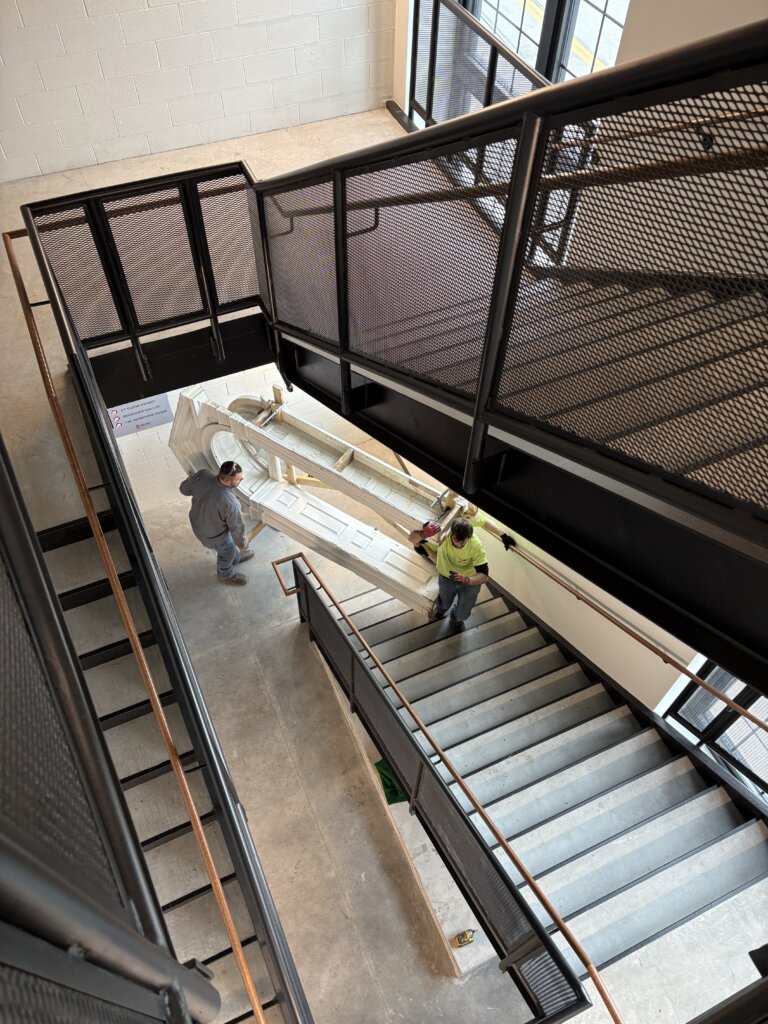 One detail: We had to move the courthouse door from the old building to the new one. It weighs 500 pounds, so it needed its own transportation. We hired Kinsley Construction to bring it over in a truck, and since it didn’t fit in our elevators, they carried it up the steps. About a week before installation, the designer messaged just to check that we’d have people on hand to get the door into place; it had to be moved about two feet. We called Kinsley back, and they took care of it in about five minutes. Those are the details you have to think about.
DF: Do you have a favorite thing to show people on a tour?
NS: Obviously the Hay coat is so unusual for that time. But I’m also a big fan of the knee buckles, the gift Gen. Pulaski gave to John Fisher. It’s an unusual personal story: Fisher became friends with the Polish general, and they exchanged gifts. We don’t know for certain what Fisher gave in return, but we do know the little general weathervane on display was made in Pulaski’s honor by Fisher’s son, Charles — that completes the story. Those personal artifacts stand out to me more than the militia letters and cannonballs.
DF: What comes next?
NS: The exhibit will stay up through December 2028. After that, we’ll be ready for something new, but that’s still to be decided.